

Beverley Plant (Adelaide).
1927 - 1945 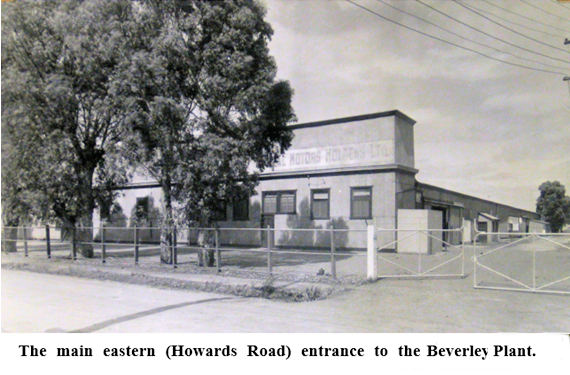
Information about the Beverley Plant is sketchy, but what is known shows that the history of the GMH Beverley Plant is heavily intertwined with Union actions which had a profound effect on the fate of this facility. Hence, the full story is almost more about Industrial actions than the plant itself. The article below skips over much of the detail to contain its length, but a more complete version is available here.
---ooo---
In 1926, the Board of Holden’s Motor Body Builders learned that General Motors Export Co. were to do their own distribution in Australia and to continue to source their body requirements solely on Holden’s Motor Body Builders. The new conditions would add approximately 4,000 units per annum for Chevrolet alone.
Resulting from this information, plans were immediately prepared covering large extensions at Woodville and to purchase outright the strategically important hardware plant of Whittingslowe Engineers Ltd. at Howards Road, Beverley, a suburb of Adelaide, who had bought the building in March, 1926. Interestingly, HMBB had earlier bought a property on the other side of Howards Road on 31st October, 1924. There is currently no information about the use this site, although GMH retained ownership until 27th February, 1948.
Holden’s took control of the Beverley site on 1st January, 1927, although they did not actually own the building until 29 February, 1928.
Activities undertaken at Beverley did not include motor body building. E. W. Holden said his firm “employed about 250 men at Beverley in the manufacture of small parts for motor bodies, and of dies for the manufacture of those parts. The materials constructed consisted mainly of metallic parts for hoods and hinges and locks for bodies. The Beverley works were divided into four sections— the engineering section, which dealt with dies, the press section, the bow section, and the blacksmith's section.”
There was the usual type of advertisement for men and boys wanted for Bench and Press work through March and April 1927 as work continued as usual.
However, in July 1927 the Beverley Engineering Unions made a bid for a 44-hour week under some recent legislation. The company disagreed that they were eligible and took them to Court, where the decision went in the member’s favour.
The whole period from 1927 until 1931 was marked by continual external strikes by coal miners, power workers, coachworkers, timber workers, and the like. There were constant disruptions to power and steel supplies so the Plant was frequently being shut down for periods from a few days to weeks at a time.
On top of this, the depression had hit Car sales hard and by 1930, had almost dried up.
It was also decided to close the Beverley Hardware plant and transfer its equipment to Woodville.
The Beverley Plant was acquired by General Motors-Holden in the HMBB/GMA merger of 1931. It now operated under the GMH banner, while Woodville continued as” Holden’s Motor Body Builders (A division of GMH)”.
Little is known of Beverley through the period 1931 – 1934, but it is highly likely there was little activity at all, as on 20th July, 1931, GMH announced that all plants with the exception of Woodville and Melbourne were to be closed down for an expected period of three years. They subsequently started to be reopened in March, 1934.
A notice appeared in the press on 8th November 1934 that General Motors Acceptance Corporation was now located at the Beverley Plant premises.
A photograph taken in 1935 shows a number of assembled Vauxhall vehicles standing around the Beverley Plant premises, giving the impression that Vehicle assembly had started sometime before.
The annual convention of South Australian dealers representing General Motors-Holden's Ltd. was opened at the Beverley plant on 28th August, 1935. Some 50 South Australian Dealers visited the plant to be addressed by GMH Management and view the facilities and Woodville.
On 6th June 1936, a 14 year old Office Boy was required for Beverley.
A GMH booklet, “The Changing Trend” was published in 1936, and stated that the Beverley plant was the Sales & Service branch for South Australia, and that it also assembled cars and trucks for South Australia.
This was borne out in 1937 when it was listed amongst an inventory of GMH plants as a Subsidiary Body Plant, occupying 5 ¾ acres.
A number of advertisements appeared through 1938 for duco Sprayers, Trimmers, and the like, showing that vehicle assembly was continuing throughout that period. However, on 30th November, the Finance Director Mr J.R. McKenzie said that “the business in South Australia had grown to such an extent that the temporary premises at Beverley had been vacated, allowing the Company to return to its assembly plant at Birkenhead”.
In 24th September 1940, an advertisement appeared calling for tenders to recondition three toilet blocks at the Assembly Plant at Howards Road, Beverley.
When war came to Australia, the Beverley plant’s main role became the assembly of artillery guns:-
- 2 Pounder Anti-tank guns and carriages.
- 6 Pounder Anti-tank guns and carriages.
- Polsten 20mm Anti-aircraft guns and gun mountings.
Parts for the guns were manufactured by sub-contractors with GMH as the main co-ordinating contractor. GMH received the various components manufactured by other contractors around Australia, except that GMH kept the most difficult and intricate parts for themselves (the gun barrel, breech block, body and the ammunition magazine) and the final assembly of the gun and carriage was undertaken at the GMH Beverley site.
The first 2 Pounder gun was completed in April 1941; by August 100 had been made, and over 300 by December.
To accommodate this volume of work, a new annex was required and Tenders were called for on 18th April 1942.
On 25th November, 1942, the Federal Government announced that it was acquiring the Beverley Plant for “Purposes of the Commonwealth at Beverley, South Australia”. GMH continued to occupy the site on lease and produce war related materials, so apart from the nominal change of ownership and the name to “General Motors Holden Ordinance Division”, this had very little impact on activities.
E.W. Holden was always looking for ways to improve the efficiency of the Plants and was keen to introduce ‘modern methods’ to achieve this. His advocacy of Piece work payment had caused Union ructions in the past, but now he turned to Time Study.
The Union leaders called a meeting of all employees from Woodville, Birkenhead and Beverley for Monday 24th January “to hold a ballot on whether they are in favour of ceasing work as a protest against continuation of Time Study methods.”
A secret ballot found in favour of striking, and the Union threatened a strike if Time Study was not stopped forthwith. Holdens referred the dispute to the Arbitration Commission on 26th January. However, when works in the Machine room started work next morning, a stop watch was used on them. So 5,000 workers at all GMH South Australian Plants went on strike, completely closing down Holden’s operations.
The Conciliation Commissioner announced that Judge O’Mara would hear the case on 7th March.
However, on 10th February, the Prime Minister Mr Curtin acting under the National Security Act, ordered the strikers to return to work pending a hearing as it was affecting the supply of war materials and had great danger of spreading to other works over the country. The strikers returned to work on 11th February.
Judge O’Mara duly commenced hearing the dispute on 7th March, and reserved his decision on 15th June, 1944.
In his decision handed down on 5th September, Judge O’Mara upheld the right of the Company to use Time Study, although he added that there were cases where he could see that Time Study could be an irritant and he was prepared to consider prohibiting use of time study in those cases.
On 27th September, the workers adopted a motion by the Dispute Committee that the whole subject of the use of Time Study was seen to be a national issue, and the Federal Councils of the Unions should meet in November to consider what was to be their attitude going forward.
Apart from a brief mention that the Vehicle Builders Union was going to discuss Time Study at their March 1945 meeting, the whole subject seems to have died away in favour of much talk about post-war reconstruction.
So, work continued at Beverley, and on 28th July, 1945, Laurance J Hartnett, when discussing post war reconstruction and preparations for the new Australian car, declared that “Woodville, Birkenhead and Beverley plants would remain the company's main manufacturing centres, that their share in the production of the complete car would be all the sheet metal work, probably the complete bodies, and the assembly of the cars for the South Australian market.”
But strikes continued to beset South Australia (and nationally). In September/October 1945 there was a six week Coal strike, which led to a steel shortage and power cuts. A Tramways strike added to the general misery. The power restrictions forced the South Australian Government to restrict power to industry, and to force the close down of industry for one week from 10th September, and for occasional shorter periods.
Arrival of a collier “Doris” early on Tuesday 16th October allowed the resumption of Industry on Wednesday 17th October, allowing some 120 workers at Beverly to return to work after a further one week shut down.
On 13th September, Prime Minister Chifley announced that the government did not intend to operate War Plants as commercial entities after the need for them was ended.
The period from October to the end of 1945 and beyond was particularly difficult for GMH, battling Power cuts, coal shortages and steel shortages which meant that Woodville Plant could not be kept going without many stoppages, ranging from a few days duration to weeks of missed production. In this scenario where the meagre resources could not keep their main plant alive, it is quite conceivable to conclude that Beverley was sacrificed to conserve supplies for Woodville. Press articles say that many smaller companies had been forced to close down by the strikes.
No exact date for the final Plant closedown has been determined but Power restrictions again forced closedown of Woodville Plant from 4th December, 1945 to 15th January, 1946, and the return to work notice does not include Beverley, suggesting that it had been closed down before then.
On April 12th, 1946, it was announced that the Federal Government had sold the Beverley land and buildings to Clarkson Ltd, the floor space of the buildings being 70.000 square feet, and the area of the land five acres. The company proposed to undertake glazing and glass products manufacturing. Additional glass-bending kilns would be installed.
Clarkson Ltd. took over the site in June, 1946, but interestingly, the sale of the land was not Gazetted by the Government until 29th August, 1946.
Photographs:
| Date | Subject | Link |
| Location map of the Beverley Plant | JPG | |
| 1925-30 | Beverley, Engineering and Smithy. | JPG |
| 1928 | Side view Beverley Plant | JPG |
| 1928 | Machinery stations set up in rows in a large workshop, believed to be at Beverley. | JPG |
| 1929 Aug 2 | Sketches of the judges in Coachbuilder's award case | |
| 1935 | Chassis and body assembly | JPG |
| 1935 | Vehicle Assembly | JPG |
| 1935 | Vauxhall and other cars parked around the front of the Plant | JPG |
| 1937 | Beverley Plant Staff Picnic to Belair | JPG |
| c1940 | Front view of the GMH Beverley Plant | JPG |
| 1941 Aug | PM Menzies visits Beverley | JPG |
| 1941 Dec 13 | Guns produced at Beverley 2 | JPG |
| 1941 Dec 13 | Guns produced at Beverley | JPG |
| 1941 Nov 6 | First completed anti-tank gun | JPG |
| 1941 Sep 29 | Anti-tank gun row at Beverley Plant | JPG |
| 1942 | Site plan of Beverley land | JPG |
| 1943 Dec 10 | G6 gun trail legs at Beverley Plant | JPG |
| 1943 Dec 10 | G6 gun trail legs at Beverley | JPG |
| 1943 Dec 10 | GH6 Gun Barrel Looking from behind and above gun, with GMH embossed on barrel. | JPG |
| 1944 Jan 28 | Strikers in park ultimatum | |
| 1945 Mar 5 | A75 Anti Aircraft guns and mountings at Beverley Plant | JPG |
| 1945 | Beverley Ordnance Division at the GMH Beverley Plant | JPG |
| 1945 | Beverley Ordnance Division at the GMH Beverley Plant 2 | JPG |
| 1946 Jan 16 | Men going back to work | JPG |
| 2019 | 39 Howards Rd Beverley today | JPG |
References:
| Date | Subject | Link |
| 1927 Jan 11 | Waterfront Over Time Claims explained | |
| 1927 Jan 27 | 5000 workers on strike at Holden | |
| 1927 Feb 03 | First payment of new Over Time rates | |
| 1927 Apr 04 | Boy has leg broken | JPG |
| 1927 Apr 27 | Man and boys wanted | JPG |
| 1927 Mar 09 | Boys wanted for Press Dept. | JPG |
| 1927 Mar 16 | Man for Bow and boys for bench and press. | JPG |
| 1927 May 07 | Beeby Award | |
| 1927 May 30 | Closed for stocktaking | JPG |
| 1927 Jul 28 | 44 Hr week | |
| 1927 Aug 02 | 44 Hour week engineers to be prosecuted | |
| 1927 Aug 03 | GMH seeks an order NISI for engineers to attend work on Saturdays | |
| 1927 Aug 03 | Beeby Award No Saturday work for engineers | |
| 1927 Aug 03 | Engineers receive summonses | |
| 1927 Aug 03 | No Saturday work by engineers | |
| 1927 Aug 05 | Workers win 44 hour week | |
| 1927 Aug 06 | Award applied to Beverley works | |
| 1927 Aug 06 | Forty Hour week case against Beverley | |
| 1927 Aug 06 | Holdens institute legal proceedings | |
| 1927 Aug 13 | 44 Hour week to apply | |
| 1927 Nov 26 | Ultimatum to strikers | |
| 1927 Nov 30 | Award terms declined | |
| 1927 Dec 05 | J Beeby to intervene with Conference | |
| 1927 Dec 08 | E.W. Holden supports payment by results | |
| 1927 Dec 08 | Strike off, ship owners unhappy | |
| 1928 Jun 30 | Wharf workers award handed down | |
| 1928 Sep 20 | Plants partially closed for waterside strike | JPG |
| 1928 Sep 22 | Some employees called to work | JPG |
| 1928 Sep 25 | Holdens resuming work | |
| 1928 Sep 26 | Waterside strike back broken | |
| 1928 Oct 03 | Adelaide ships worked by volunteer labour | |
| 1928 Oct 10 | Tool Room Employees to report for work | JPG |
| 1928 Dec 07 | Holdens Partial Closure at Christmas | |
| 1929 Jan 30 | Holdens may close due timber workers strike | |
| 1929 Jan 31 | Timber workers on strike | |
| 1929 Feb 25 | E.W.Holden denies rumour of GM takeover | |
| 1929 Mar 09 | Carriage makers wage board determination due | |
| 1929 Jul 26 | Payment by results case Beverly description | |
| 1929 Jul 30 | Coachmakers application for 44 hour week | |
| 1929 Jul 31 | Coachbuilders 44 hour claim day 2 | |
| 1929 Aug 01 | Work at Holdens dirty | |
| 1929 Aug 02 | Statement that Holdens not sold to USA | |
| 1929 Aug 02 | Work of women should be 44 hours | |
| 1929 Aug 03 | 44 hours for women | JPG |
| 1929 Aug 13 | Only one in four motor firms make money | JPG |
| 1929 Aug 16 | Holdens Recruiting Station upsets workers | |
| 1929 Sep 11 | Holden to give a weeks notice | JPG |
| 1929 Sep 11 | Holdens interpretation of award | |
| 1929 Dec 04 | E.W. Holden: 48 Hour decision "a fine thing" | |
| 1929 Dec 04 | Coachmakers lose fight for 44 hour week | |
| 1929 Dec 18 | Holdens men stood down over Christmas | JPG |
| 1930 Apr 26 | Beverley only receive goods Monday to Wednesday | JPG |
| 1934 Nov 10 | GMAC now located at Beverley | |
| 1936 Jun 06 | Office boy wanted for Beverley | JPG |
| 1936 Aug 17 | Tests to find diphtheria carrier failed | JPG |
| 1935 Aug 27 | South Australian Sales Convention at Beverley | |
| 1935 Sep 28 | Dent knocker wanted for Beverley | JPG |
| 1935 Sep 13 | GMH position on Coachbuilders strike. | |
| 1937 May 29 | Duco liner and stripper wanted | JPG |
| 1938 Feb 03 | Duco sprayer wanted | JPG |
| 1938 Feb 12 | Man loses eye sight at Beverley | |
| 1938 Mar 02 | Assemblers wanted | JPG |
| 1940 Sep 24 | Tenders to renovate lavatories at Beverley GMH | JPG |
| 1941 Apr 25 | Lord Gowrie visits Beverley | |
| 1941 Aug 09 | 100th Gun handed over at Beverley | |
| 1941 Aug 09 | Menzies visits Beverley | JPG |
| 1941 Aug 09 | Appreciation of Anti tank gun work | |
| 1941 Nov 20 | Sir Ronald Cross visits Beverley | |
| 1941 Dec 13 | Holdens work on anti tank guns at Beverley | |
| 1941 Dec 13 | Two Pounders roll off production lines at Woodville and Beverley | |
| 1942 Apr 18 | Tenders to construct annex for GMH Beverley | JPG |
| 1942 Dec 17 | Government Gazette: Beverley site acquired by Fed Govt. for Government Purposes | |
| 1944 Jan 22 | Union ballot to check if stop work wanted | JPG |
| 1944 Jan 26 | Workmen to await manpower investigation | JPG |
| 1944 Jan 27 | Time study strike at Holden | |
| 1944 Jan 28 | Strike of 5,000 men at Holdens | |
| 1944 Jan 28 | Strikers in park ultimatum | |
| 1944 Jan 29 | Talks fail to settle strike | |
| 1944 Feb 01 | GMH reject union proposal | |
| 1944 Feb 01 | Strikers vote to stay out | |
| 1944 Feb 02 | Dispute in Court | |
| 1944 Feb 03 | Reconciliation official to visit Adelaide | |
| 1944 Feb 04 | Federal moves in time study strike | |
| 1944 Feb 07 | Union Disputes committee to take over strike | |
| 1944 Feb 09 | Strikers reject return to work | |
| 1944 Feb 10 | PM Curtin orders men back to work | |
| 1944 Feb 11 | Strikers return to work | |
| 1944 Mar 07 | Day one of Time Study strike hearing | |
| 1944 Mar 08 | Second days proceedings of Time Study Strike hearing | |
| 1944 Mar 09 | "Exhaustion danger" under time study reported | |
| 1944 Mar 10 | Witness used intimidation on workers reported | |
| 1944 Mar 11 | Idling by men seen as result of time study | |
| 1944 Mar 13 | Denied any knowledge of speed up | |
| 1944 Jun 14 | No alternative to time study | |
| 1944 Jun 15 | Case decision reserved | |
| 1944 Jun 13 | Mr H.W. Rymill's evidence | |
| 1944 Sep 05 | Right to use time study upheld | |
| 1944 Sep 06 | Union delay response for three weeks | |
| 1944 Sep 27 | Employee's offer to Holden | |
| 1944 Nov 11 | Badge show check | |
| 1946 Jan 14 | Woodville and Birkenhead to reopen | JPG |
| 1946 Jan 15 | End of power restrictions | |
| 1945 Jul 28 | L.J. Hartnett says Woodville, Birkenhead and Beverley remain main plants | |
| 1945 Sep 13 | Govt to close down War Plants | |
| 1945 Oct 16 | Beverley to remain closed until Wednesday | JPG |
| 1945 Oct 16 | Plants resume work after power cuts | |
| 1946 Apr 12 | Clarksons to buy GMH annex | |
| 1946 Apr 12 | Government sell Beverley plant to Clarksons | |
| 1946 Aug 29 | Government Gazette: Sale of Beverley land |